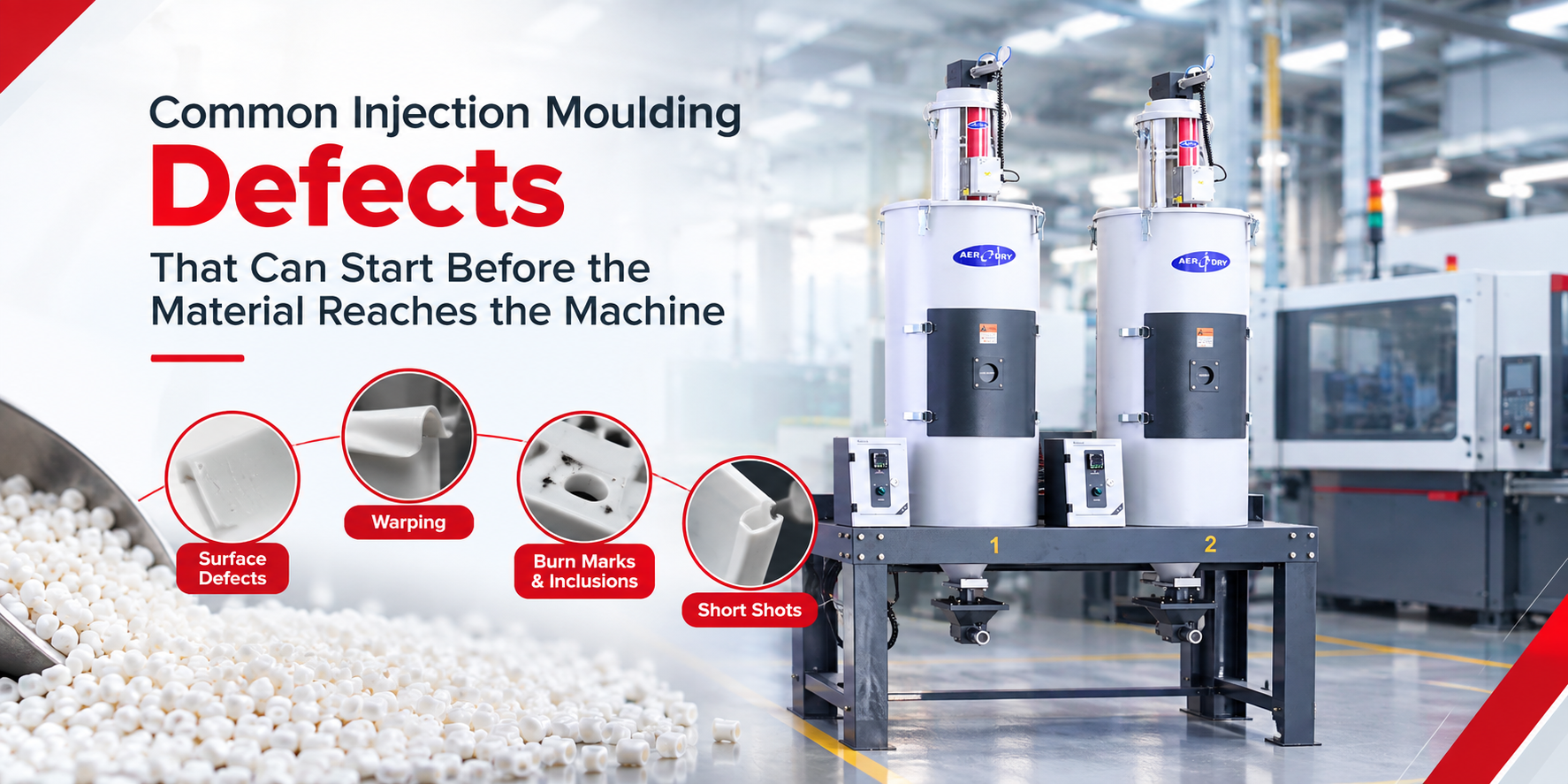
When an injection-moulded part develops silver streaks, dimensional variation, brittleness or other quality issues, machine settings are often the first place manufacturers look. Injection speed, pressure, melt temperature and mould conditions all influence part quality, but the condition of the resin entering the machine are i equally important.
For moisture-sensitive polymers, insufficient drying can affect melt processing and may, in some cases, lead to surface defects or polymer degradation. Variations in material feeding or contamination can introduce additional inconsistencies into the process.
This is why troubleshooting should not focus solely on the injection moulding machine. Material preparation-including storage, drying, conveying and feeding is part of the process itself.
When resin reaches the machine in a consistent and appropriate condition, the moulding process has a better starting point for achieving repeatable output.
Why Material Preparation Matters in Injection Moulding
Before resin reaches the injection unit, several stages can affect its condition and ultimately, the consistency of the moulding process..
| Process |
Description |
| Storage |
Influences the amount of moisture the material may absorb before processing. |
| Drying |
Ensures moisture-sensitive materials are brought to the required processing condition. |
| Conveying |
Transfers the material from storage or drying equipment to the injection moulding machine. |
| Feeding |
Ensures that the required material is delivered to the machine consistently throughout production. |
These stages are interconnected. Even a properly dried resin can r reabsorb moisture if it is exposed to ambient conditions during handling or conveying. Similarly, a well-designed drying system cannot compensate material that is inconsistent, improperly handled or contaminated before it enters the process.
For moisture-sensitive polymers such as PET, PA, PC and other engineering plastics, proper drying requirements are particularly important. The appropriate drying conditions vary depending on the polymer, its initial moisture content, drying temperature, residence time, and the manufacturer's processing recommendations.
The objective is not to simply “dry the plastic.” to condition the material to the appropriate moisture level before processing and maintain that condition until it reaches the injection moulding machine.
4 Injection Moulding Defects That May Be Linked to Material Preparation
Not every defect originates in material preparation. Injection moulding defects have multiple causes, including mould design, machine settings, material properties and processing conditions. However, the condition of the should also be considered when troubleshooting certain defects where moisture, contamination, or inconsistent material feeding may be contributing factors.
1. Silver Streaks and Splay
Silver streaks, commonly known as splay, appear as thin, silvery or whitish marks on the surface of a moulded part.
Moisture in the resin can vaporise during processing and contribute to splay, particularly when processing hygroscopic materials. The resulting vapour or gas can disrupt the melt and become visible on the surface of the finished part.
However, moisture is not the only possible cause. Splay can also be associated with trapped air, contamination, excessive shear, material degradation or inappropriate processing conditions.
When moisture-related splay is suspected, manufacturers should examine the resin's storage, drying conditions, handling and time between drying and processing, along with machine and mould parameters.
2. Bubbles and Voids
Bubbles and internal voids can arise from a range of factors, including material shrinkage, inadequate packing, trapped gas, mould design and processing conditions.
Material preparation can also contribute in some cases. Excess moisture, contamination or volatile substances in the resin may generate gas during processing. Inconsistent material condition can further complicate troubleshooting particularly when appears inconsistently from one cycle to another.
For this reason, troubleshooting should consider both process parameters and material condition. Rather than attributing every bubble or void to the moulding machine, a systematic approach should be used to understand whether the underlying cause is related to the material, mould, machine, or processing conditions.
3. Dimensional Variation
Dimensional variation is often associated with changes in mould temperature, melt temperature, injection pressure, cooling conditions, packing or material behaviour.
Inconsistent material preparation can add another source of variation. If the resin's moisture condition, composition, or feeding rate changes, the way the material melts and flows may also change.
This is especially significant in high-volume production, where small variations repeated across thousands of cycles can translate into increased rejection rates.
Maintaining consistent material condition and feeding helps remove one potential source of process variability.
4. Loss of Mechanical Properties
Not all quality problems are visible immediately after moulding.
For moisture-sensitive polymers, excessive moisture during processing can promote hydrolytic degradation, reducing molecular weight and consequently, mechanical properties.
As a result, a moulded component may appear visually acceptable while its strength, toughness, or long term service performance has already been compromised.
For applications where mechanical performance is critical, material preparation should therefore be regarded as an integral part of quality control—not merely a preliminary production step.
How Proper Resin Drying Supports Consistent Injection Moulding
Not all plastics respond to the moisture in the same way. While some materials primarily experience surface moisture, hygroscopic polymers can absorb moisture into their molecular structure. The drying method must therefore be selected according to the specific material and its moisture condition.
Key drying parameters such as temperature, airflow, residence time and dew point should be considered based on the polymer’s requirement and the required processing condition.
A hopper dryer heats and circulates air through the resin to remove moisture before the material enters the injection moulding process. For hygroscopic materials, dehumidifying dryers can provide controlled, low-dew-point air to achieve the drying conditions required by the polymer and help prevent moisture from being reabsorbed.
The goal is not simply to achieve a particular dryer temperature. The resin must achieve the required moisture level and remain protected from moisture re-absorption until it is processed.
Proper resin drying helps reduce moisture-related defects, improve melt consistency and provide more consistent material behaviour throughout the injection moulding process.
Why Material Conveying and Feeding Matter Too
Drying is only one part of effective material preparation.
Once resin has been dried, it must reach the injection moulding machine without unnecessary exposure to moisture, contamination or inconsistent handling.
Manual material handling can introduce variability through open exposure, contamination risks and interruptions in material supply. In a high-volume production environment, these seemingly small issues can become significant when repeated across multiple machines and production cycles.
Automated hopper loaders can transfer material from a central source or storage system directly to the machine hopper. Depending on the system configuration, automated conveying can reduce manual handling, improved material flow and create a more controlled and consistent material-supply process.
For centralized material-handling systems, factors such as conveying parameters, pipeline design, material characteristics and system configuration should be considered to ensure that the material reaches the machine reliably while compromising the preparation achieved upstream.
Building a Consistent Material Preparation Process
A reliable injection moulding process begins well before the resin enters the injection unit. Consistent production depends on maintaining material condition throughout the entire preparation and delivery process.
A material preparation system should consider the complete sequence:
Storage → Drying → Conveying → Feeding → Processing
Each stage can influence the next.
| Step |
Process |
Description |
| 1 |
Storage |
Resin should be stored in conditions appropriate for the specific material, while minimizing unnecessary exposure to moisture, dust and other sources of contamination. |
| 2 |
Drying |
The drying system should be selected to suit the polymer's moisture characteristics and the specific requirements of the intended processing condition. |
| 3 |
Conveying |
The conveying system should transport the material reliably while minimizing the risk of contamination and unnecessary exposure to ambient conditions. |
| 4 |
Feeding |
Material should reach the machine consistently and at the required feed rate to support stable processing conditions. |
| 5 |
Processing |
The injection moulding machine then processes material under controlled conditions, with the material’s condition maintained as consistently as practical throughout the process. |
This integrated approach is particularly important when multiple injection moulding machines operate from a centralized material-handling system. A problem at any stage of the system can affect multiple machines if it is not identified and properly controlled.
What Happens When Material Preparation Is Not Controlled?
Poor material preparation does not always result in an immediately visibledefect. In many cases, the more significant issue is increased process variability and reduced consistency.
Depending on the material and application, manufacturers may experience:
- Moisture-related surface defects
- Variation in material behaviour during processing
- Increased rejection and scrap rates
- Inconsistent part dimensions
- Reduced mechanical properties
- Material contamination
- Unplanned production interruptions
- Increased troubleshooting and process-adjustment requirements
When these problems appear, adjusting machine parameters may provide a temporary solution without addressing the underlying material condition.
A more effective troubleshooting approach considers the entire process—from material storage and preparation to moulding and final inspection.
How to Evaluate a Material Drying and Handling System
Before selecting a hopper dryer or material-handling system, manufacturers should evaluate the following factors:
| Priority |
Factor |
Description |
| 1 |
Polymer characteristics |
Determine whether the material is hygroscopic and identify the drying conditions recommended for the specific polymer. |
| 2 |
Moisture condition |
Understand the material's initial moisture content and the moisture level required before processing. |
| 3 |
Throughput |
Match the drying and conveying capacity to the actual material consumption of the production process. |
| 4 |
Residence time |
Ensure the material remains in the drying system for sufficient time under the specified moisture conditions. |
| 5 |
Drying-air conditions |
For moisture-sensitive materials, parameters such as dew point and airflow should be properly controlled. |
| 6 |
Material temperature |
Ensure the drying temperature is appropriate for the polymer and doesn't adversely affect the material. |
| 7 |
Storage and exposure |
Minimize unnecessary exposure to ambient moisture after drying. |
| 8 |
Conveying configuration |
Consider the conveying distance, routing, material flow and number of machines being supplied by the system. |
| 9 |
Contamination control |
Design the material handling system to minimize the risk of contamination during material movement. |
| 10 |
Future requirements |
Consider production expansion and additional machines or material lines when designing centralized systems. |
The right system should be evaluated based on the specific material requirements and plant configuration, rather than selecting equipment solely on nominal capacity.
How Aerodry Supports Material Preparation for Injection Moulding
Material preparation is an interconnected process In which drying, conveying and feeding work together to deliver the required material to the injection moulding machine in the required condition.
Aerodry provides drying and material-handling solutions for plastics-processing applications, enabling manufacturers to develop material preparation systems based on their polymer requirements, machine configuration and production conditions.
Depending on the application, solutions may include hopper dryers, dehumidifying drying systems, hopper loaders and centralized material-handling configurations.
The engineering consideration is not simply which dryer or loader to install but how the complete material-preparation system should be configured so that the resin reaches the processing machine in the required condition, at the required rate and with minimal handling-related variability.
For manufacturers operating multiple injection moulding machines, this process-oriented approach can also help create a more structured and controlled material-handling environment across the plant.
Consistent moulded parts begin with consistent material preparation. Controlling to the condition of the resin before it reaches the injection unit is therefore an important part of controlling the overall moulding process.