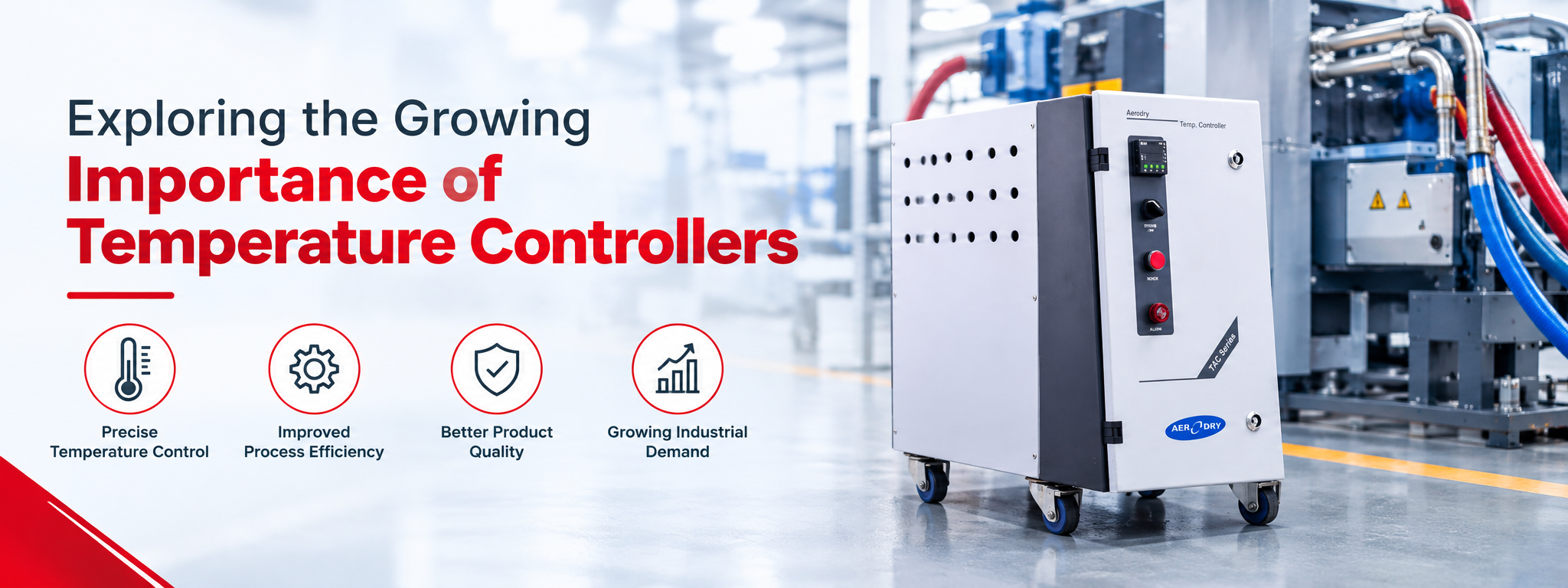
The industrial manufacturing in India has undergone tremendous changes over the past two decades, driven by a myriad of developments. One of the most significant developments in recent years have been the advancement of technologies. Several industries such as pharmaceuticals, specialty chemicals, and others that have experienced significant developments, to maintain precise process conditions and controlled environments. The importance of temperature control hsas grown significantly over the past few years. There has been a growth in the number of manufacturers of temperature controllers for large-scale industrial systems.
In industries such as pharmaceuticals, it is very important to precisely maintain the temperature throughout the manufacturing process is essential. Even the slight fluctuations in the required temperature can compromise the quality of the product and incur manufacturing losses for the organisations. There are a number of aspects that contribute to the increasing importance of temperature-controlled machinery, and this blog explores them in this blog.
Understanding the Importance
It is essential for industries to understand why the use of temperature control equipment such as air-cooled chiller has become indispensable in modern manufacturing. For instance, - in pharmaceutical industry, thousands of different kinds of formulations are being produced d day in and out, each with specific temperature requirements. The system is equipped with both heating and cooling regulators that are specifically designed to maintain the required temperatures. With the advancement of modern technologies, temperature-control equipment features automatic sensors that are able to constantly monitor and regulate the temperature without requiring any human intervention.
As large-scale industrial environments become increasingly dynamic, the need for precise temperature control is increasing. Modern temperature control machinery is equipped with Resistance Temperature Detectors that automatically monitor and regulate temperature according to the present set points.
Also Read: Choosing the Right Pneumatic Conveying System for Modern Plastic Manufacturing
Rise in Demand across Sectors
In high-value industries such as semiconductor manufacturing, food processing, and pharmaceuticals, temperature sensitive process has have become critical. To begin with, the U.S. Food and Drug Administration (FDA) and the European Medicines Agency (EMA) have rolled out strict guidelines for maintaining specified temperatures conditions throughout all manufacturing units. This is because even a minute fluctuation in temperature has the capability to compromise a complete batch of drugs.
Similarly, in the food and beverage industry, the requirement for temperature control equipment such as water-cooled chillers plays a vital role in order to ensure the perfect quality of products at the time of packaging. Critical processes, including pasteurisation, refrigeration, fermentation, and others require precise temperature regulation to ensure product safety and quality.
In industries like semiconductor many of the components and materials used in microchip production have a very low tolerance for temperature fluctuations, and every slight increase in the temperature can adversely affect the product quality. As a result the adoption of advanced temperature-control systems has become mainstream across the global business landscape.
Also Read: How Advanced Gravimetric Systems Improve Accuracy in Modern Manufacturing
Achieving Energy Efficiency
The increasing costs of energy and growing environmental concerns have made temperature control systems increasingly important today. This machinery helps industries save significant amounts of energy. In many commercial buildings, the widespread usage of HVAC temperature control equipment has significantly reduced in the consumption of energy.
Concluding Thoughts
The factors discussed above clearly illustrate why the importance of temperature controllers has significantly grown across the industrial ecosystem over the years. Manufacturers of these products continue to adopt emerging technologies and integrating advanced features into their products, to meet evolving industry requirements. Considering all the developments taking place in this segment, the demand for efficient and reliable temperature-control systems is expected to increase further in the years ahead.